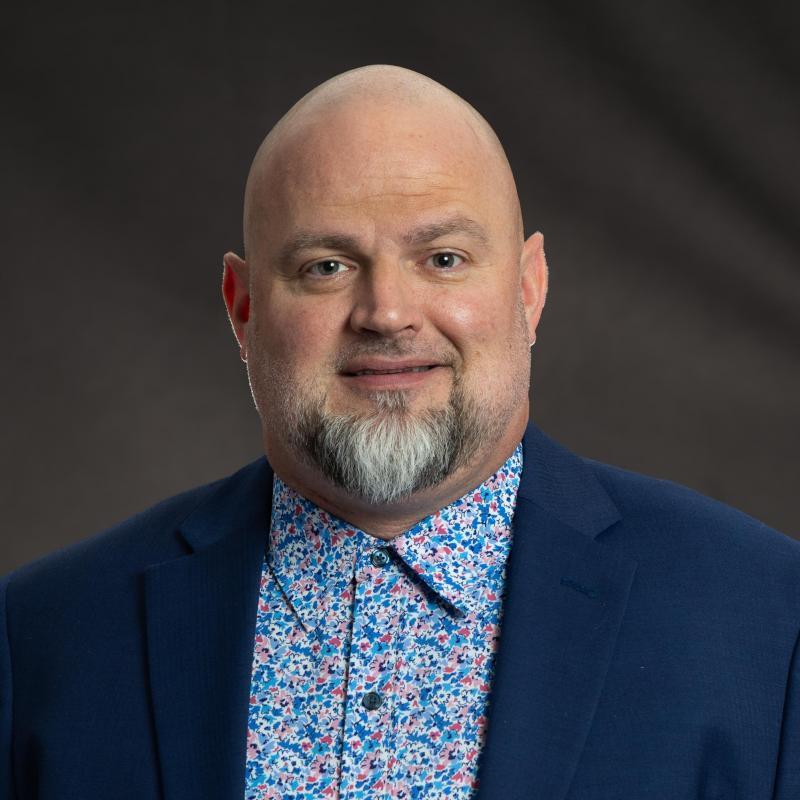
Although he may not describe himself this way, principal and union leader Brian Galbraith of Prince George’s County, Maryland, is a social justice champion. Diversity, equity and belonging have been hallmarks of his career, from his early days as a schoolteacher in Nevada to his current role as a principal in Maryland.
Born and raised in Curtisville, Pennsylvania, a mining town north of Pittsburgh, Brian grew up with family members who worked in the coal mines and steel mills. He lived in an extended family household with several relatives, including his great-grandmother.
“They gave me a great sense of family and responsibility, which holds true today,” he says. His parents were firm believers in always being there for family.
His many teachers also helped shape him into an educator and an advocate for those less privileged than himself.
“To this day, I can name every teacher I ever had,” he says.
He especially remembers Mr. Favero, his English teacher and a Notre Dame graduate who understood his students and watched football games with them. His physics teacher, Mr. Stropkaj, was also influential. And Ms. Miller, who led the musical theater program, won his heart.
“As the class clown, I would get football buddies to do musical theater with me,” he says.
Although football was his main sport, Brian also played basketball and participated in track and field. He says, “I would show up at school at 7 in the morning and leave at 9 or 10 at night.”
At Slippery Rock University, Brian had an adviser, Dr. Gary Quast, who organized an opportunity for student teachers to travel to Las Vegas. Brian went along. As a student teacher, he reported to a young woman named Miecha. Unbeknownst to either of them at the time, they would eventually marry and have four children.
Brian went on to earn certification in gifted and talented education and a master’s degree in educational leadership. In Nevada, he began his career as an elementary school teacher and eventually became a gifted and talented teacher. He worked at Jydstrup Elementary School, Swainston Middle School, Parson Elementary School and, finally, Smith Elementary School.
His students came from all over the world, including American, Mexican, Syrian, Chinese, Japanese, Croatian and Filipino backgrounds.
Brian also began his administrative career in Las Vegas as a dean of students at Bob Miller Middle School. There, he quickly learned the importance of being part of a strong administrative team.
He loved connecting with students, starting chess clubs and science fairs, and sharing as much knowledge as possible.
“I still keep in contact with many of those kids,” he says.
By then, Brian and Miecha were married and had welcomed their first child, Amelia. They decided to move to Maryland to be closer to Miecha’s parents. Brian soon landed a position as an assistant principal at G. James Gholson Middle School, followed by another at Samuel P. Massey Academy, a kindergarten-through-eighth-grade school in Prince George’s County.
At the time, Prince George’s County was the wealthiest majority-minority county in the United States. Initially, most of Brian’s students were African American, but the community would soon become increasingly diverse, with growing African American and Latino populations.
“I found my place in the world!” he says.
A major turning point came when Brian was named principal of Carrollton Elementary School, where he could focus more directly on issues of diversity.
A couple of years later, however, he was called to the central office, first as a Title I instructional specialist and then as an executive specialist.
“These were tremendous experiences. I loved working in a Title I role, checking on compliance and so on,” he says.
Even in those positions, Brian made time to ask other school leaders to identify students who could benefit from additional support. During school visits, he would make a point of checking in with those students.
“I knew it would serve me well,” he says.
And it did. In 2018, Brian was named principal of Cherokee Lane Elementary School, where he is now entering his ninth year.
“I had always mentored students, and so I did there, too. It’s my way of staying connected to students as long as possible,” he says.
Today, many of Cherokee Lane’s students have backgrounds in El Salvador, Panama, Honduras, Colombia, Chile and Brazil. Families appreciate seeing Brian enjoy their traditional foods and regularly attend his monthly “Coffee with the Principal” gatherings. Students are also happy to see him greeting them with a high-five during morning drop-off and afternoon dismissal.
“But I always remember my privilege. I always remind my staff to remember their privilege, especially now with all the ICE raids affecting our families,” he says.
A strong champion of community schools, Brian works to provide families with as many resources and services as possible. These include health care, vision and dental services, a food pantry, and indoor and outdoor gardens, including a mini-greenhouse. Families and students are learning how to grow their own vegetables and become more self-sustaining.
Cherokee Lane has grown from 500 students to nearly 1,000.
“At Cherokee Lane, I’m blessed with an incredible team,” he says.
Brian invites everyone he meets to visit the school and see its work firsthand.
“I try to make a social justice difference,” he says. “I try hard.”
Balancing his role as principal with his responsibilities as president of the Association of Supervisory & Administrative School Personnel of Prince George’s County, AFSA Local 109, has also been a significant challenge.
“It’s quite a significant challenge,” he says. “I would love for our local president to do only that, and so I decided against running again. I have actually been out of being a sitting president for a few weeks. It has to be a full-time job. A lot goes into running the local, and in partnership with the executive director, members could benefit. It would be great if it could be a full-time position.”
Serving on AFSA’s General Executive Board has been a joy. He appreciates how the organization brings local unions together and allows members to address national, state and local issues. The national union also brings the voices of school leaders to the forefront of public attention.
“Of course, there are the great benefits,” he adds, “and maybe above all, there’s the national searchable database of contracts.”
As hard as it may be for some to believe, Brian’s favorite pastime is spending time with his family.
“I consider time with Miecha and my kids as time to myself,” he says.
Their four children are growing up quickly. Amelia is now an elementary school teacher, Alexa is a college sophomore, Charlie is a high school junior, and Isla is in middle school. Brian makes it a point to attend all their activities and has coached them in field hockey, lacrosse and basketball.
“I’m serious that this is my greatest recreation,” he says.